Education Guide
Real diamonds. Real brilliance. Created with intention — and backed by science, certification, and full transparency.
Jump to the 4Cs ↓
The Basics
"Chemically, physically, and optically identical to a diamond pulled from the earth."
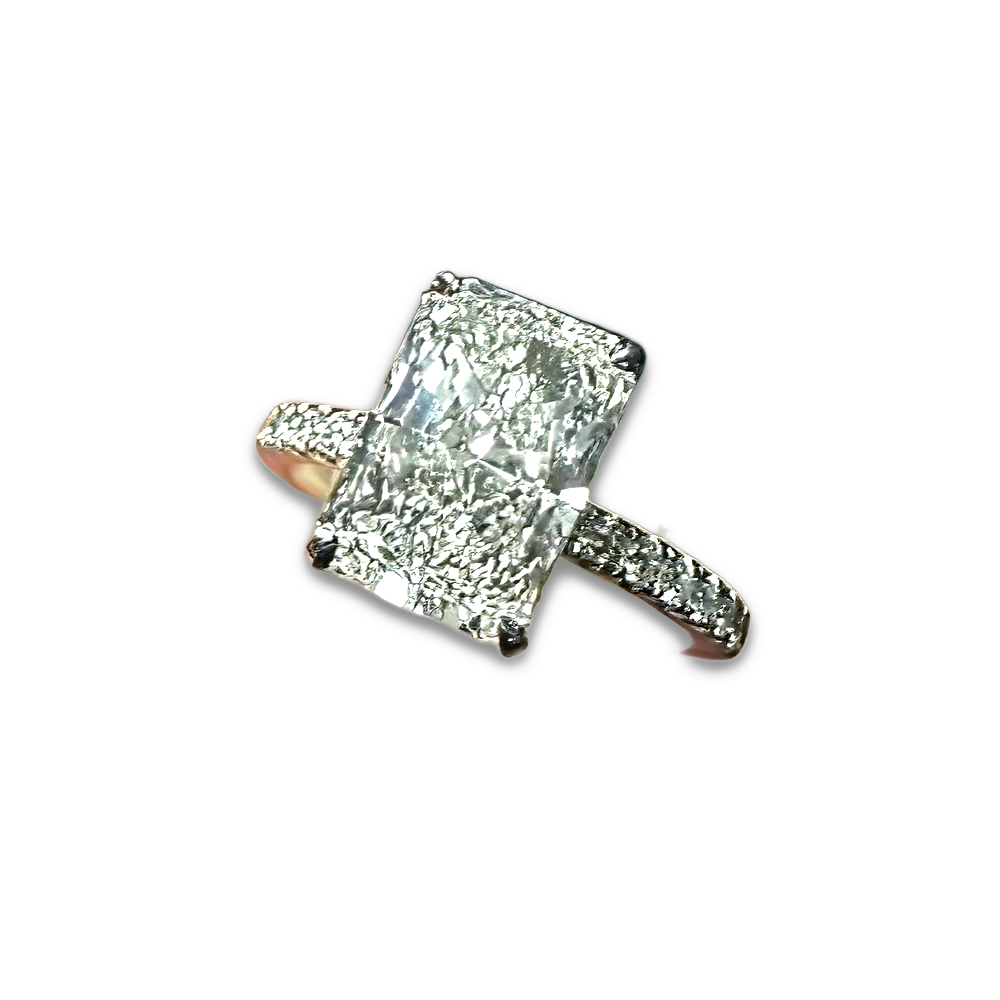
A lab-grown diamond starts with a tiny diamond seed crystal. Using one of two advanced processes, pure carbon is built up around that seed under precisely controlled conditions — growing a complete diamond crystal over a period of weeks.
The result is not an imitation. It is not glass, cubic zirconia, or moissanite. It is a diamond — the same material, the same structure, graded by the same standards, and indistinguishable even under a professional jeweler's loupe.
The only difference is origin. And for many people, that difference is a meaningful one.
Side by Side
| Property | Lab-Grown | Earth-Mined |
|---|---|---|
| Chemical composition | Pure carbon (C) ✦ | Pure carbon (C) |
| Crystal structure | Cubic crystalline | Cubic crystalline |
| Hardness (Mohs) | 10 / 10 | 10 / 10 |
| Refractive index | 2.417–2.419 | 2.417–2.419 |
| IGI / GIA grading | ✦ Yes | ✦ Yes |
| Conflict-free | ✦ Always | Varies |
| Full supply chain transparency | ✦ Yes | Often limited |
| Price vs. equivalent mined stone | ✦ 30–50% less | Market rate |
| Environmental impact | Significantly lower | High (land + water use) |
✦ Lab-grown diamonds may have slightly lower resale value than mined, though both markets fluctuate. The primary value is in wearing and enjoying your diamond.
How They're Made
Method One
A diamond seed crystal is placed inside a sealed chamber and exposed to carbon-rich gases (typically methane) at low pressure. Microwave energy ionizes the gas into plasma, breaking down the molecules and depositing pure carbon atom by atom onto the seed — growing the diamond layer by layer over 6–10 weeks.
Method Two
This process replicates the conditions deep within the earth where natural diamonds form. A diamond seed is surrounded by carbon source material and metal catalyst, then subjected to extreme pressure (~1.5 million PSI) and heat (1,300–1,600°C). The carbon dissolves and migrates to the seed, crystallizing into a diamond over several weeks.
Grading Standards
Lab-grown diamonds are graded using the exact same standards as mined diamonds, by the same independent laboratories — primarily IGI. Your certificate covers all four criteria.
The most important of the 4Cs — cut determines how well the diamond reflects light. A well-cut diamond captures light and returns it as brilliance, fire, and scintillation. Cut grades range from Excellent to Poor.
✦ We recommend: Excellent or Very Good
Diamond color is graded on a D–Z scale, from colorless (D) to light yellow (Z). The less color, the rarer and more valuable the stone. Lab-grown diamonds span the full color spectrum, with D–F being the premium colorless range.
✦ Sweet spot: G–H (near-colorless, great value)
Clarity measures internal inclusions and surface blemishes on an 11-grade scale from Flawless (FL) to Included (I3). Lab-grown diamonds tend to have fewer inclusions than mined, as the growth process can be closely controlled.
✦ Eye-clean at: VS2 or better
Carat is the unit of weight (1 carat = 0.2 grams). Larger stones are rarer and command higher prices — but cut and clarity can make a 1ct diamond appear larger or smaller than its weight suggests. Carat is one factor, not the only one.
✦ Our collection: 0.5ct – 4ct range
Your Documentation
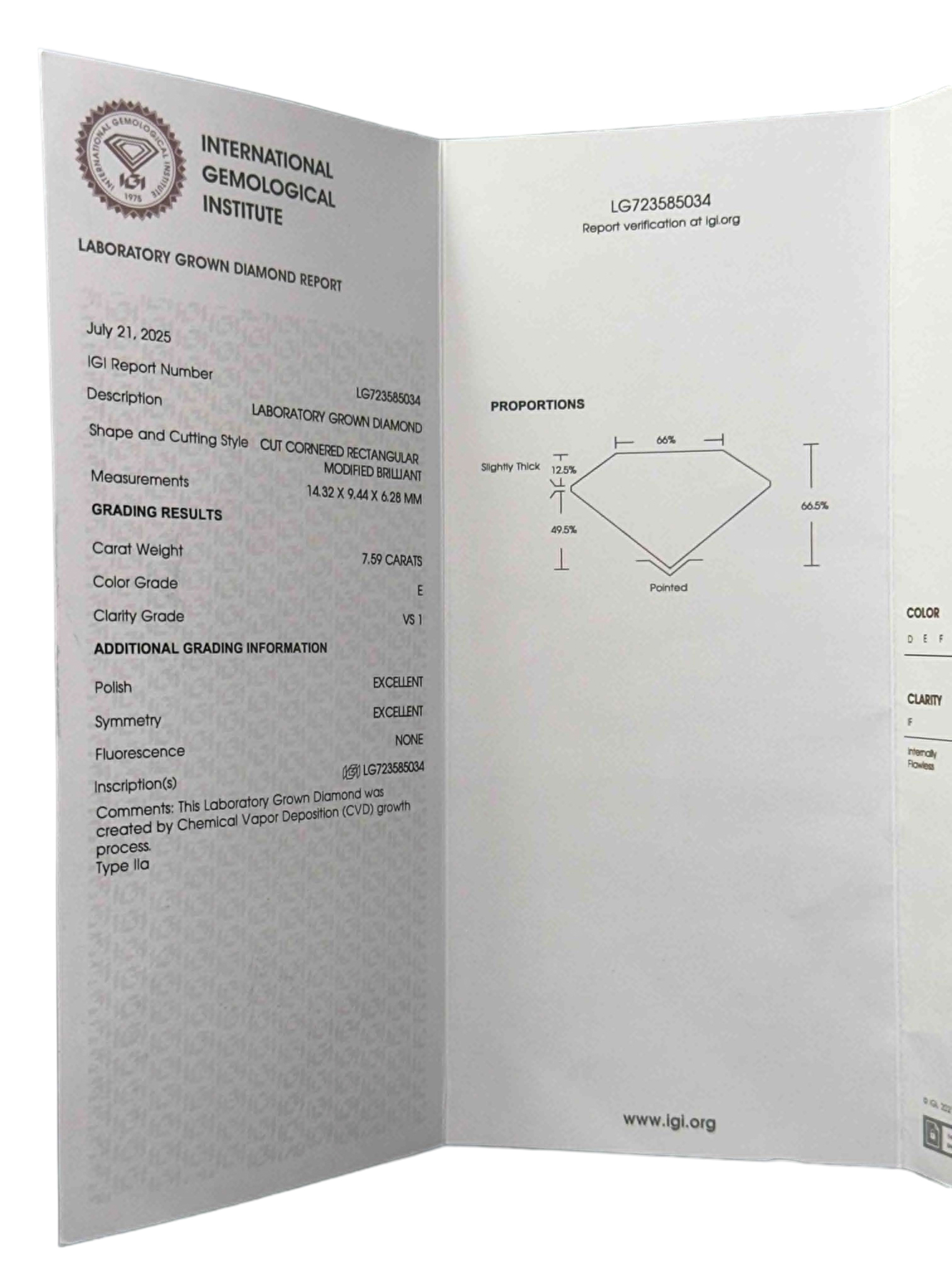
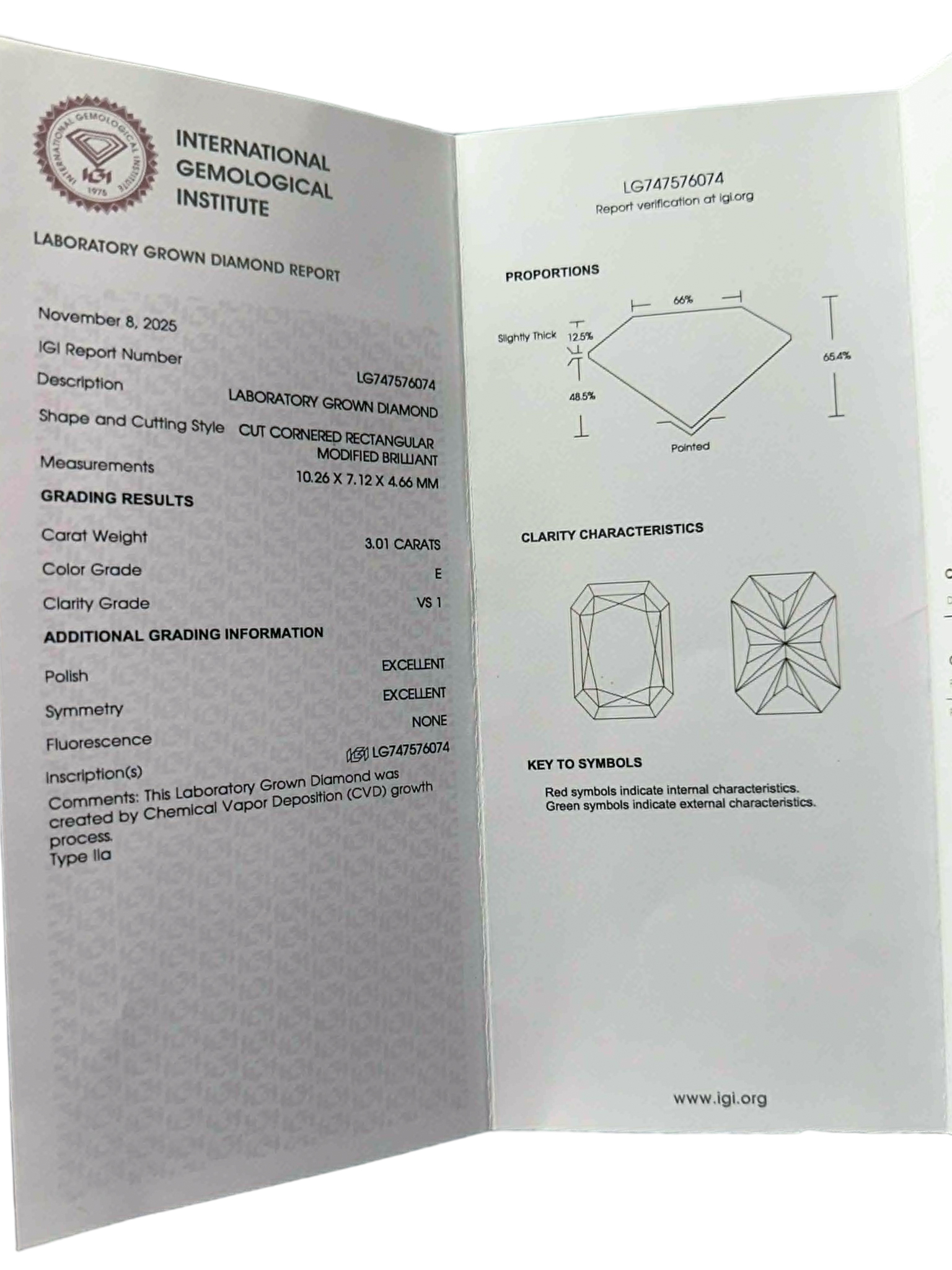
Every diamond we sell comes with its IGI grading certificate — a permanent, tamper-proof record of your stone's exact specifications. Here's what real certification paperwork looks like.
IGI Certificate
Grading Report — Page 1
Cut · Color · Clarity · Carat
IGI Certificate
Grading Report — Page 2
Proportion diagram · Finish grades
Click any image to enlarge · All certificates are originals, not copies
Common Questions
Yes — unambiguously. Lab-grown diamonds have the same chemical composition (pure carbon), the same crystal structure, the same hardness (10 on the Mohs scale), and the same optical properties as mined diamonds. The FTC recognizes them as diamonds. Even a professional gemologist cannot distinguish one from the other without specialized equipment that tests growth characteristics.
No. To the naked eye — and even under a jeweler's loupe — a lab-grown diamond is indistinguishable from a mined diamond. Both exhibit the same brilliance, fire, and scintillation. The only way to identify a lab-grown diamond is through advanced spectroscopic testing that examines the stone's growth patterns, something only available in specialized gemological laboratories.
Lab-grown diamonds currently have lower resale values than mined diamonds of equivalent quality — largely because the cost to produce them continues to decrease as technology improves. However, the same is true for mined diamonds, which rarely retain full purchase value at resale. Most people buy diamond jewelry to wear and enjoy, not as a financial investment. The significant price difference upfront allows you to get a larger, higher-quality stone for the same budget.
Yes — every diamond we sell comes with a full IGI (International Gemological Institute) grading certificate. This document details the exact specifications of your stone: cut grade, color grade, clarity grade, and carat weight, along with proportion diagrams, finish grades, and the stone's unique identification number. The certificate travels with the stone and is yours to keep permanently.
Diamond mining has significant environmental impact — it requires moving massive amounts of earth, uses large quantities of water, and can result in habitat disruption. Lab-grown diamonds use a fraction of the land and water, and the energy footprint continues to shrink as facilities shift to renewable energy sources. While no manufacturing process is entirely without impact, lab-grown represents a meaningfully lower environmental footprint for an equivalent stone.
Absolutely — custom orders are one of our specialties. You choose the stone (shape, carat, color, clarity), the metal, the setting style, and every detail. We handle sourcing the certified stone and crafting the piece to your specifications. Custom orders typically take 3–4 weeks and require a deposit. Use our AI ring designer to start visualizing your piece, then contact us to bring it to life.
Ready to Find Yours?